How Long to Rest Between Sets

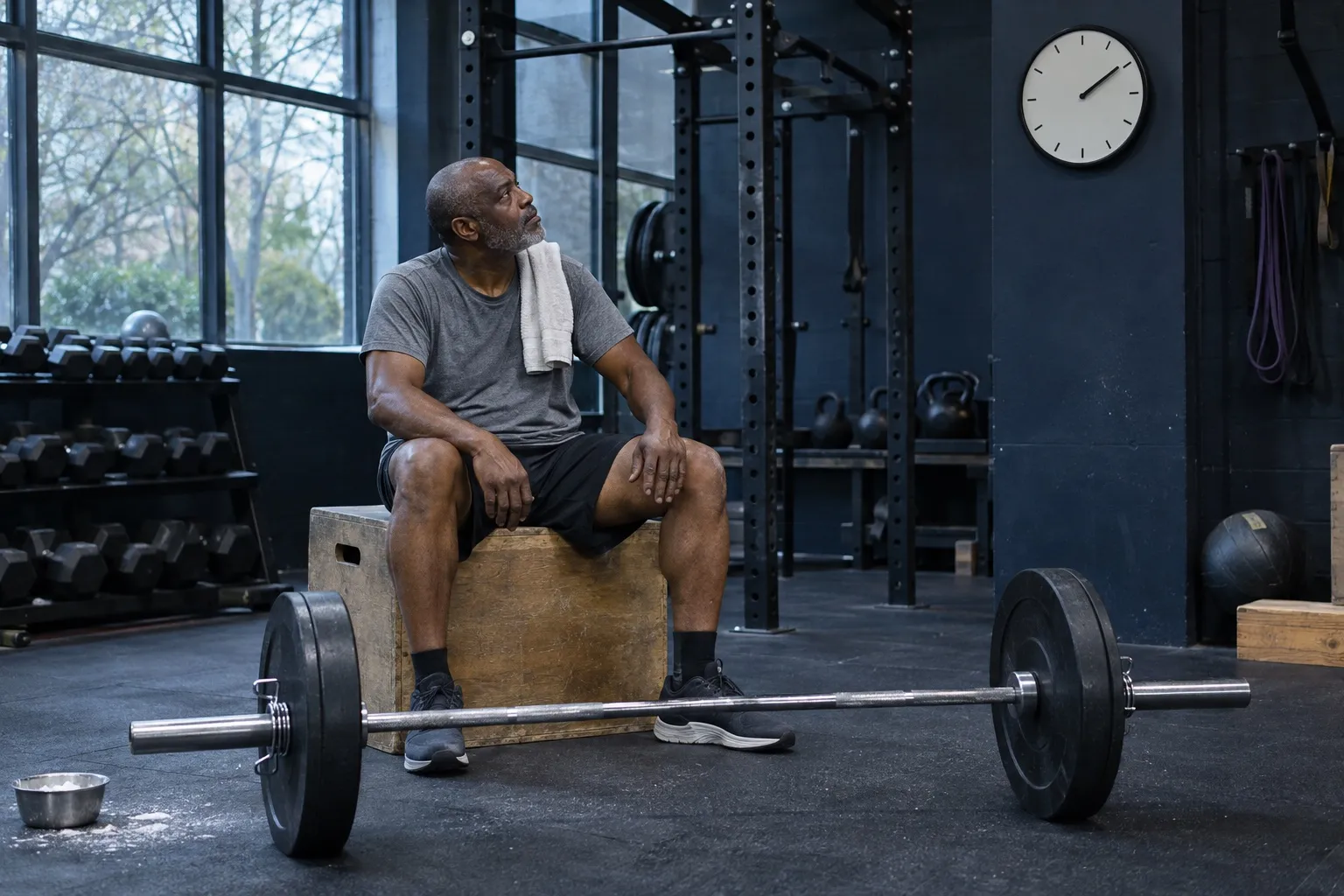
Rest longer than feels necessary on your heavy lifts, and shorter on small ones. For most people that means two to three minutes between sets of squats, presses, and deadlifts, and about a minute or two between sets of curls, raises, and other smaller exercises.
Rest isn’t wasted time. It’s what lets your next set be as good as your last.
Why rest matters
Each hard set tires the muscles you used and the nervous system driving them. Rest is how they recover enough to do it again. Cut rest too short and your next set loses reps or weight, so you end up doing less real work, not more.
Short rest makes a session feel harder, because you’re out of breath and sweaty. That feeling isn’t the same as training more effectively. For strength and muscle, the quality of each set counts for more than how tired you feel.
How long to rest, by goal
These ranges are practical starting points.
| Goal | Big compound lifts | Smaller exercises |
|---|---|---|
| Strength (heavy, low reps) | 3 to 5 minutes | 2 minutes |
| Muscle size (moderate reps) | 2 to 3 minutes | 1 to 2 minutes |
| General fitness | 2 to 2½ minutes | 1 to 1½ minutes |
| Muscular endurance (high reps) | 1 to 1½ minutes | 45 to 60 seconds |
Big compound lifts move a lot of weight with several large muscles: squats, deadlifts, bench presses, overhead presses, rows, and pull-ups. Smaller exercises work one area at a time, like curls, lateral raises, leg extensions, and calf raises.
Two more factors push the number up or down:
- Free weights need a bit more rest than machines. A barbell squat demands balance and bracing that a leg press doesn’t, so give it an extra 30 seconds or so.
- Heavier and closer to failure means longer rest. A set of 5 with one rep left in reserve needs more recovery than a set of 12 with three left.
For timed holds like planks, 45 to 60 seconds between sets is usually enough.
Signs your rest is too short
You’re probably resting too little if:
- Your reps drop off sharply from set to set, such as 10, then 7, then 5 at the same weight.
- You’re still breathing hard when you start the next set of a heavy lift.
- Your form gets sloppy on later sets even though the weight hasn’t changed.
Your reps will fall a little across sets anyway. A drop of one or two is normal, but larger drops usually mean you need more rest.
Signs it’s too long
Resting much longer than you need is rarely a problem for your results, but it can make sessions drag. If you’re fully recovered and waiting around, start the next set. Ten minutes between sets of curls isn’t helping.
Keeping sessions on time
Longer rest on big lifts adds up. Three sets of three compound lifts with three minutes of rest is already close to half an hour before warm-ups. When time is tight:
- Cut a set, not the rest. Two good sets beat three rushed ones.
- Pair smaller exercises. Alternate two exercises that don’t compete, such as a curl and a calf raise, and rest between pairs. Keep this for smaller exercises, not your heavy lifts.
- Keep warm-up sets brief. Rest only as long as you need between light warm-up sets.
- Time your rest. It’s easy to lose track. Two minutes passes quickly when you’re changing plates, and slowly when you’re scrolling.
How StrengthBuddy handles rest
When StrengthBuddy builds a program, it sets rest from your goal and the type of exercise. On a strength goal, compound lifts on free weights rest 3:30, other compound lifts (machines, cables, and bodyweight) rest 3:00, and smaller exercises rest 2:00. Building muscle and general fitness use 2:30, 2:00, and 1:30. An endurance goal uses 1:30 for compound lifts and 1:00 for smaller ones. When a session runs long, the app drops sets to fit your time instead of cutting rest.
The rest timer starts when you check off a set and shows on your Lock Screen. A chime tells you when rest is up, and it plays through your headphones even with your iPhone on Silent.
The short version
- Rest 2 to 3 minutes on big lifts and 1 to 2 minutes on smaller ones for most goals.
- Rest longer, up to 5 minutes, on heavy strength work.
- If your reps fall off a cliff, rest longer.
- When time runs short, drop a set instead of rushing your rest.