Progressive Overload, Explained

Progressive overload means asking your body to do a little more over time. Your muscles and nervous system adapt to the work you give them. Once they’ve adapted, the same work stops pushing them to change, so you have to raise the demand bit by bit.
That’s the whole principle. The rest of this guide is about how to apply it without getting hurt or stuck.
The five ways to do a little more
Adding weight to the bar is the most obvious form of overload, but it’s one of several.
- More weight. Lift the same sets and reps with a heavier load. This is the main driver of strength.
- More reps. Do more reps with the same weight. 3 sets of 10 at 100 lb is more than 3 sets of 8.
- More sets. Add a set to an exercise. This raises your weekly volume, which matters most for building muscle.
- Better reps. Same weight and reps, but with a fuller range of motion, more control, or less help from momentum. This counts, and it’s often the right step on a new exercise.
- More frequency. Train a lift or muscle more often during the week.
Less rest between sets can make a session harder, but it usually lowers the quality of your sets, so it’s a weak form of overload for strength and muscle. How long to rest between sets covers why.
For most people, weight and reps do nearly all the work. Add sets when you want more muscle and have the time. Use better reps when you’re learning a movement.
Start with double progression
The simplest reliable method is double progression. You work in a rep range, first adding reps, then adding weight.
- Choose a range, such as 3 sets of 8 to 10 reps.
- Start with a weight you can lift for 8 clean reps on every set, with about two reps left in the tank.
- Each session, try to add a rep or two somewhere.
- When you get 10 reps on every set, add weight next time.
- The heavier weight drops you back toward 8 reps. Build up again.
| Session | Weight | Reps per set |
|---|---|---|
| 1 | 135 lb (61 kg) | 8, 8, 8 |
| 2 | 135 lb | 9, 8, 8 |
| 3 | 135 lb | 10, 9, 9 |
| 4 | 135 lb | 10, 10, 10 |
| 5 | 140 lb (63.5 kg) | 8, 8, 8 |
It works for almost every exercise, it adjusts to good and bad days on its own, and it never asks you to guess. If you’re putting together your first gym program, this is the rule to use.
How big a jump?
Use the smallest jump your equipment allows. Small jumps keep you in your rep range, and they add up.
- Lower-body barbell lifts (squat, deadlift): 5 to 10 lb (2.5 to 5 kg).
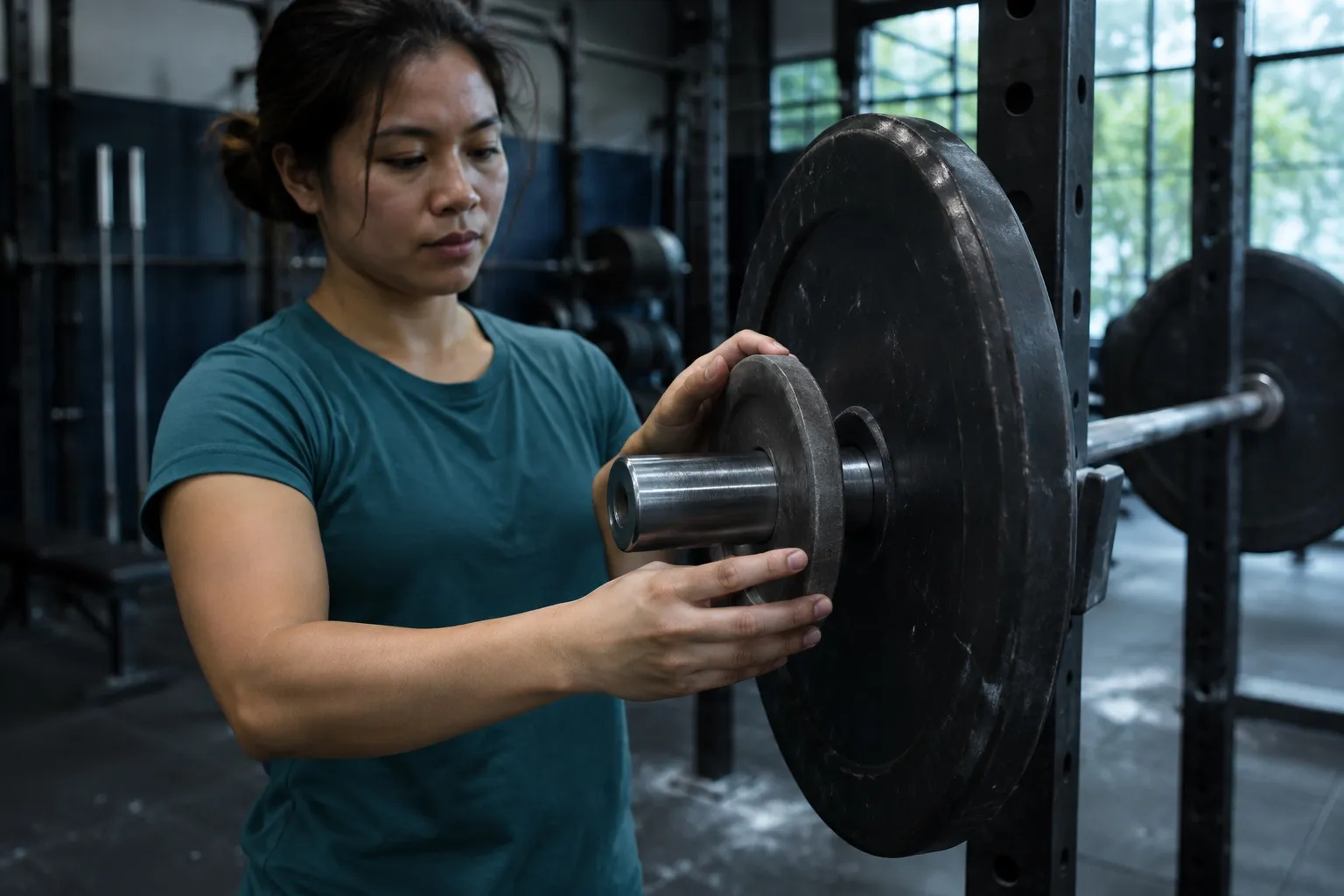
- Upper-body barbell lifts (bench press, overhead press, row): 2.5 to 5 lb (1 to 2.5 kg). Small change plates help a lot here.
- Dumbbells: the next pair up, often 5 lb (2.5 kg) heavier. That’s a bigger jump on a small exercise, so expect to drop more reps, or build up to the top of a wider range first.
- Machines: the next pin. If the stack jumps are big, add reps for longer before moving up.
How fast should you progress?
Faster at first, then slower. That’s normal, not a sign that something’s wrong.
- First few months: many beginners can add weight to their main lifts every week or two, sometimes every session on lower-body lifts.
- After six months to a year: progress usually slows to adding reps for a few weeks, then a little weight.
- Years in: a few pounds more on a lift over several months is real progress.
Your upper-body lifts, especially the overhead press, will progress more slowly than your squat and deadlift. Smaller muscles can’t add load as fast.
When it stops working
Sooner or later you’ll miss your reps at the same weight for two or three sessions in a row. Before changing your program, check the basics:
- Sleep and food. A few short nights or a stretch of eating little can stall a lift that was moving.
- Rest between sets. Rushed rest costs reps.
- Form drift. If the weight went up but your depth or range shrank, you didn’t really progress.
If those are fine, you have a few options:
- Reset. Take about 10 percent off the weight and build back up with the same rules. You’ll usually pass your old best within a few weeks.
- Change the rep range. Moving from 8 to 10 to 5 to 7 lets you keep adding weight for a while.
- Swap the variation. Trade a flat bench press for an incline, or a back squat for a front squat, for a few months.
If a lift hurts beyond normal muscle soreness, don’t push through it to keep progressing. Stop that exercise and have it checked by a qualified professional.
Track it, or it doesn’t happen
You can’t do a little more than last time if you don’t know what last time was. Write down the weight and reps for every working set. Before each session, look at the last time you did it and decide where you’ll add the rep or the weight.
The log also shows you the bigger picture. Over months, a slow rise in weight or reps on your main lifts is the clearest sign your training is working.
The short version
- Do a little more over time: more weight, reps, or sets, or better reps.
- Use double progression: build reps to the top of a range, then add the smallest weight jump.
- Expect fast progress at first and slower progress later.
- When you stall, check sleep, food, rest, and form, then reset or change the rep range.
- Keep a log, because overload depends on knowing what you did last time.